Thursday, October 14, 2010
Not so, Daddy-o
Come back soon for comments on some very interesting work on atheism by pscychologist, Paul Vitz.


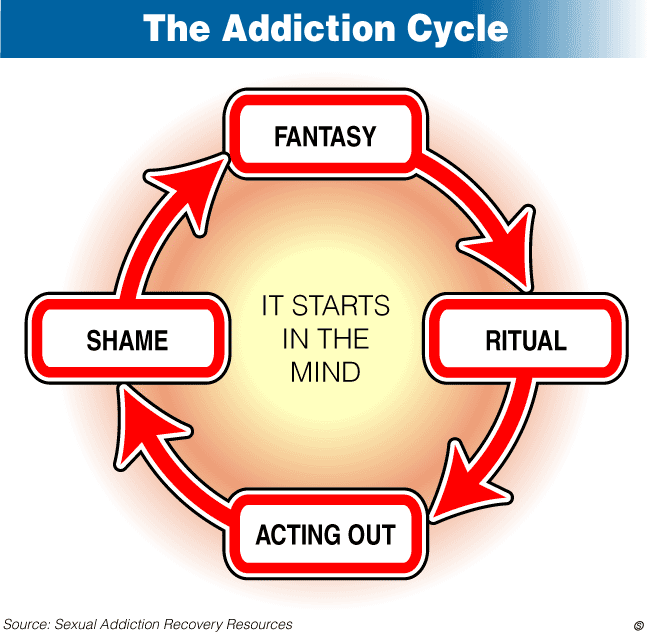
Addiction
1 Cor 10 11These things happened to them as examples and were written down as warnings for us, on whom the fulfillment of the ages has come. 12So, if you think you are standing firm, be careful that you don't fall! 13No temptation has seized you except what is common to man. And God is faithful; he will not let you be tempted beyond what you can bear. But when you are tempted, he will also provide a way out so that you can stand up under it.
I'm not a follower of metal, but I happened to read the interview by Beliefnet.com of "Fieldy" from Korn. Fieldy remained with the band, unlike Brian Welch who converted earlier and left. The question was posed to Fieldy, "Do you have advice for our readers who may be struggling with addiction?", to which he replied, "Remove yourself from wherever the craving is. If you're in the kitchen and you're craving some chocolate cake, go outside and go on a run or go on a walk. Remove yourself [completely]--not walk into a living room. Go get your mind on something else and do something else." He also referred to the verse at the top of this post as one that has been powerful in helping him.
I like the way Paul implies that none of us are undergoing a "special harrassment" by temptation, but that they are experienced by everyone (even Jesus).
Are we willing to trust the Lord completely, to the point becoming Whom we behold? Are we willing to be transformed daily, by the renewing of our mind, instead of conforming to the pattern of the world, despite its constant bombardment of our experience with everything ungodly? Seems the time-tested priciple of delayed gratification is ever present.
Sunday, October 3, 2010
Pray for Persecution?

I watched a clip of Jim Daly, Pres of Focus on the Family, on Fox news a few days ago, and he made a comment that stuck. He said that in 1996, he was leaving China, and the Christian nationals who took him to the airport said they were praying for more persecution of the church in the U.S.
Why would they do that? I can offer some speculation. For one thing, the church (mostly underground) in China is getting HUGE (I heard 70 million a few years ago), praise God. Are we noticing any lessons from history? Persecution has a powerful purging, purifying effect. The lukewarm are out of there as soon as it sets in, in effect "weeding the garden". And then the church grows like a weed. The very young Christian church was persecuted by the Jews, then the Romans, and it has persisted in various places it seems, with little or no interruption on the globe.
I also heard about an incident, where it was claimed (I believe by Hal Lindsey in "Combat Faith"), that armed gunmen entered a secret assembly of Christians, implying they were going to kill any believers, but those who did not claim Christ could leave. After the less courageous had gone, the intruders put down the guns and said, "Sorry to put you through that, but we have to be cautious - now let's worship."
Will things ever reach such a point in the U.S. ? If the "cycle of nations" before God in history is any indication, then eventually; yes. Perhaps we SHOULD pray for it. Although the early Christians didn't seek martyrdom, if they were accused, many bravely admitted it and considered it an HONOR to go to their death for the Lord, singing hymns on the way to the arena. If it happens in our time, how will we respond? Are we loyal to Jesus to the death? Can we love and forgive those who hate our guts, even as they kill us? Clearly, there's no stronger way to shine the light of Jesus on a dark world.
Thursday, September 2, 2010
Gospel Authorship

We should keep in mind the historical way the gospels and indeed, the entire New Testament came about. There is an unbroken chain of custody of the material written by the Apostles and their direct students (the requirement for authoritative canon, of which the Christian community was well aware). The official canon declaration at Nicea, in AD 325 was a formality only. I still wait for someone to explain to me how a forger could have snuck his material into acceptance by foundational or subsequent Christian leadership and community. Why was the work of the Apostles accepted? They were empowered by the Holy Spirit, which Jesus sent to work miracles and speak with power. No wonder written work was not accepted from just anyone.
Sunday, August 29, 2010
Is God Out to Getcha?

How do I know what God's nature is? Has He spoken to me from a burning bush? No, but He has left word for us in the inspired scripture of the Bible. I know, some folks dismiss it as written myth, just like any other man-made religion. I only recommend that before you do that, you study the scripture for yourself, genuinely seeking the truth, rather than accepting someone else's criticism and comments on it. Many folk appear to have rejected it based on the latter, while conversely, others have set out to thoroughly study the Bible for themselves in order to disprove it, only to experience total transformation through conversion to Christ.
I know that even believers in Christ are often not immune to the misconception that God is watching, like Big Brother, waiting for them to misstep so He can swat them. Nothing could be further from the truth. It is true, that God is holy and just and, similar to a human judge in our courts, cannot remain so while leaving wrongdoing unpunished. Make no mistake, there IS a judgment coming wherein He will do exactly that. But here is the good news about the matter; God actually wants everyone to be saved.

2 Peter 3 9The Lord is not slow in keeping his promise, as some understand slowness. He is patient with you, not wanting anyone to perish, but everyone to come to repentance.
1 Timothy 2 3This is good, and pleases God our Savior, 4who wants all men to be saved and to come to a knowledge of the truth. 5For there is one God and one mediator between God and men, the man Christ Jesus, 6who gave himself as a ransom for all men—the testimony given in its proper time.
So the blood of the cross then, is His gift to us to pay the "fine" that we had coming. Some seem to be unable to make sense of this good news and the Bible even declares it to appear as foolishness to those who are perishing.
However, the inability of man to earn salvation and the grace God offers through His own suffering is unique to Christianity. All other religions offer a legalistic system wherein one does good in the hopes of maybe achieving Heaven. In Christ however, we may know that we are saved (1 John 5:13). Jesus said to fear not man but God, Who can cast the soul into Hell, and that is indeed an excellent starting point for someone to turn toward God. If we remain selfish and immature, of course fear shall remain, but with maturity, fear must give way to love.
1 John 4 15If anyone acknowledges that Jesus is the Son of God, God lives in him and he in God. 16And so we know and rely on the love God has for us. God is love. Whoever lives in love lives in God, and God in him. 17In this way, love is made complete among us so that we will have confidence on the day of judgment, because in this world we are like him. 18There is no fear in love. But perfect love drives out fear, because fear has to do with punishment. The one who fears is not made perfect in love.

Do you wish to be free from the fear of death, judgment and the wrath to come? You can be, but not on your own and not without trust. Does it take a blind, flying leap of faith? No, but it does take a small, reasonable step of faith. Take the step!
Friday, August 27, 2010
Does DNA Contain Information?

Since we're focusing on whether or not it required intelligence to come to its current state, let's examine that aspect of information and see if it qualifies. Interestingly, it appears muchas sources secular refer to the DNA code as information. This source actually used the DNA example in its definition OF information: http://www.merriam-webster.com/dictionary/information
Considering the example from computer code (which I assume we agree had an intelligent source), Bill Gates said, "Human DNA is like a computer program but far, far more advanced then any software ever created[1]." Some consider it quote mining for a creationist to use his quote, since he did not mean it in a creationist context, but I'm considering here his comparison of DNA to computer code, which he is qualified to comment on. We could also legitimately compare protein building by DNA to the CAD/CAM industry, where computer code is read by manufacturing machines which mold, cut and assemble items accordingly. For serious info-science types, a full article by Gitt, in which he discusses Shannon's earlier information theory, as well as the information-bearing properties of DNA can be found here: http://wernergitt.com/down_eng/G_1533_Information_science_and_biology.pdf
But let's look at it from a language perspective. Let's consider for this discussion that information is a series of symbols that convey meaningful ideas to a receiver (I believe this matches or is close to the definition proposed by commenter, ExPatMatt). If I spell the word "B-A-T", I encode information as a sequence of symbols that can be read by the receiver through a conventional system of interpretation known as reading the English language. Now if I further sequence multiple words into sentences and sentences into paragraphs, I increase the information and compound the meaning conveyed. We could even consider the context in which I placed the sentences to increase meaning to a "meta-information" level. We've all heard of quote mining, where a quote is taken out of the context intended by the author. Now compare this to shaking the Scrabble letter bag and picking them out randomly and placing them in a row on the table. The same symbols are used, but have no meaning. True, the word "B-A-T" could turn up randomly by coincidence, but would be of low quantity and quality, not to mention we would could easily tell which sequences were random and which were applied by their specified complexity. If on the table next to the one with the random "B-A-T" sequence, we saw "T-H-E B-A-T B-I-T T-H-E R-A-T", we would know it was not coincidence, but a deliberate sequence.
On to a comparison with DNA. The four nucleotide bases, A, T, G and C represent letters. A sequence of three bases (a codon) carry the info for assembling an amino acid or a word in our example. The sequence in which the amino acids chain together determine the identity and function of the protein being built, which in our example would be a sentence. The way the proteins are assembled form cellular type and structure (muscle, bone, organ, etc.), or "paragraphs", and onward and upward we go, until we have the multiple volumes that constitute a human being (about 30,000 genes, each an average of about 12,500 base-pairs). The entire genome of DNA information for an organism is contained in every one of trillions of cells.
Though some want an exception in this case, in all of human experience, information has only arisen from an intelligent source. This is why I agree that DNA is indeed God's signature on every cell. The more we study DNA, the more we realize that the genes formerly considered "junk" are being found to have non-protein coding, regulatory function (shrinking levels of vestigial code should represent a problem for evolution, btw) What's really amazing is that about 20% of DNA can also be read backwards for additional information! Don't worry, it's totally free of Satanic messages. I say with my science hero, Louis Pasteur, "The more I study nature, the more I stand amazed at the work of the Creator."
[1] Gates, 1995, Education: the Best Investment, p.188
Friday, August 20, 2010
Will Evidence Really be Enough?

I hear this one quite frequently, so lets have a go at it. The demand is for evidence, but rarely am I given what will constitute sufficient evidence. Evidently, just hearing of Jesus Christ and His redeeming work from another is sufficient for some; for others, reading it in the Bible; for others (like Lee Strobel), a careful look at the historicity and reliability of scripture; for others (like me) add on observations of nature and human behavior to solidify it; and for still others MAYBE a miracle would suffice.
 I said maybe, because even eyewitnesses of miracles weren't always convinced (John 11:43-48, Matthew 9:32-34), and make no mistake, it wasn't because they doubted the legitimacy of the miracles themselves. Unlike the TV charlatans we see today, Jesus healed people (as did His apostles later) known for decades by entire communities to be infirm. No, the rejection in these cases were from a hardness of heart - an unwillingness to believe. Why? Is it because with acceptance comes accountability? Perhaps a perceived loss of freedom?
I don't believe we are currently in a miraculous period, but God makes it clear that we don't need miracles to believe in Him and that creation is enough (Rom 1:18-23). I also suspect that within each of us is something that resonates, however quietly, with the Truth of God when we hear it. My vote is, we should heed it. And if you are one who has run away from God or even resorted to fighting against Him, here's what happens when you genuinely and humbly return (click). What's stoppin' ya?
Wednesday, August 18, 2010
Gamblin' Pascal

I don't typically use Pascal's Wager as an argument for several reasons. First, I don't want to logically "twist the arms" of someone in an attempt to convert them, which probably won't succeed anyway if they are in a state of rebellion against their Maker. Second, even if they accept the logic, I don't want them to accept God's salvation in Jesus Christ as "fire insurance, just in case" - the commitment has to be all or nothing.

Pascal's argument essentially states that it's safer to serve God as though He exists since there is everything to gain and nothing to lose. With one exception, I don't at this time recall the substance of arguments against Pascal, however I am interested in hearing some, since his logic (like the Kalam Cosmological Argument) seems so sound. I guess that makes sense. He was a mathematician and competent with probability.
Fire away.
Monday, August 16, 2010
Intelligent Design (ID)

The Search for Extraterrestrial Intelligence (SETI) project was astronomer Carl Sagan's baby and he was definitely atheist. Can we see how the criteria SETI is using to identify intelligent signals from unintelligent ones are the same criteria used by ID on DNA information coding? There is no disputing that DNA qualifies as information code (approximately 20-base digital), and nowhere in human experience has information formed spontaneously, without intelligent agency.
Francis Crick, of Nobel Prize fame for DNA molecule structure discovery, looked for a way that the nature of the nucleotide chemistry might naturally order the base-pair sequence, but no dice. Just as the Scrabble letter tiles have no magnetic strips that form them into words when dumped on the table, DNA has no self-ordering mechanism internal to its nucleotide chemistry - it is simply-code building blocks with information imposed upon it. God's signature on every cell.
Is this the one case where we want to invoke an exception to information theory, in order to avoid the larger implications? Another alternative, suggested by Crick (and more recently by Dawkins) is panspermia (seeding of Earth with life by aliens), but you can predict the next question. It only defers the problem.
ID however, is pursuing the science of establishing and using criteria for distinguishing intelligent design from random occurrence. Looking at the two images in this post, we can easily discern which of the two was intelligently designed and which likely occurred randomly. Why are we able to do so? What qualificaiton criteria are we using? Is it inductive reasoning from the large scope of human experience? If it were common for wind and rain erosion to carve detailed human-face shapes in rock, would things be different?
Thursday, August 12, 2010
Dino What?

One author wrote that even in liquid nitrogen, it wouldn't have lasted 65my. He was referring to the dino soft tissue discovered in the femur of a T-Rex fossil by Dr. Mary Schweitzer on a dig in Montana. They had to break the bone to helo-lift it and she analyzed a sample from inside it, by demineralizing it in the lab and surprise, there was still material left. Unfossilized material. This type of discovery has occurred over a dozen times since. Some pics: http://www.google.com/images?hl=en&q=dino%20soft%20tissue&um=1&ie=UTF-8&source=og&sa=N&tab=wi&biw=1004&bih=612 .
This is one of my favorite creation science topics, but it fascinated me to see how entrenched is the secular, deep-time paradigm, to the point that a mysterious preservation mechanism was immediately sought, rather than making age calculations based on the known decay rates in that environment. After her colleagues looked into the microscope and perceived blood cells, Schweitzer asked, "How can that be, when [the sample] is 65myo?" Some Christians (like Schweitzer) accept theistic evolution, some reject it (like me, although I used to accept the possibility), but atheism needs it. Dino soft tissue discovery has been confirmed (careful on the dates of your sources if you follow up) and is here to stay, so interpret it as you will, but my question: Is this the providence of God, giving yet another chance for the light of Christ to shine on you? Think deep.
Wednesday, August 11, 2010
Objective Morality

As to the objectivity of morality, I agree. Much like logical arguments (i.e. All Spaniards are European and John, being a Spaniard, is therefore also European. Or 2 + 2 = 4), which are axiomatic and conclusive, if morality is objective, we can say with just as much certainty it is wrong to steal. But when we ask how long have these conclusions been true, it becomes apparent that the answer is always or from the beginning. In fact, since logic and morality are attributes of God, they have been true from eternity (separate from time).
As for moral motives, some posit that it's less noble to do good from a fear of punishment or promise of reward. Those actually sound like pretty good reasons to me, but I'll extend it further, in that those motives are a good starting point for moral development. They must with maturity however, give way to love. 1 John 4 says "17In this way, love is made complete among us so that we will have confidence on the day of judgment, because in this world we are like him. 18There is no fear in love. But perfect love drives out fear, because fear has to do with punishment. The one who fears is not made perfect in love." So doing good for it's own sake seems an intellectual exercise in futility. Let us instead, do good for love's sake - and God is love.
Sunday, August 8, 2010
No True Scotsman/Christian Equivocation

Here's the difference: A Scotsman is universally identified, not by his behavior, but by his place of origin/residence. If guilty of heinous crimes, he is simply a diabolical Scotsman, so Flew's example is sound. A true Christian however, is identified (by Jesus Christ) as one who knows and abides in Christ and bears fruit accordingly (Matt 7:15-23). This criteria was established by the Lord before group membership started and is therefore not a subcategory but the category, and cannot be equivocated with No True Scotsman. Yes, there are those who claim (like Hitler) to be disciples of Jesus Christ, but clearly according to Jesus, they are not.
So the world was given the right and means by God Himself to distinguish true Christians from false ones. I hope you will take this into consideration and not use the "church hypocrite" reason for rejecting Jesus and the salvation He offers. Of course the church has plenty of hypocrites (1 Pet 4:15-18) - don't follow them; follow the Prince of Peace - the One and Only, and fear death no more!
Friday, August 6, 2010
Angry (A)theists

There must be an explanation, since it seems that a true atheist wouldn't care what the Christian believes, and the concern a true Christian should have for the lost should not manifest itself as anger.
Wednesday, August 4, 2010
Infinite Regression of Origins

Some in the unbelieving community appear to latch on to certain concepts without considering their ultimate implications. Ray Comfort is fond of saying that an atheist believes that nothing created everything, with which I mostly agree, since most atheistic reasoning on origins leads there, and that which does not is faulty from the start.
For example, if one subscribes to a materialist process of evolution of all living things, the next logical question is how life got started at all. Many atheists seem to prefer to keep evolution and abiogenesis (life from nonlife) separate, and while the two concepts may be considered individually for scientific purposes, philosophically, they are quite inextricable. Not only that, but the sequence continues infinitely with the repeating question, "And before that?" Thus, the problem of infinite regression.
How can we resolve the problem? One could postulate that the universe has simply always been, without beginning and without end. The flaw with this proposal is time. Time cannot extend infinitely into the past (perhaps familiar to those acquainted with the Kalam Cosmological Argument), or we could never have arrived at this moment. This is how medieval philosophers knew 1000 years prior to the big bang theory that the universe had a beginning. Since the material universe consists of space-time, only a being or condition independent of this continuum could logically have no beginning or end, which of course is a description of God of the Bible - the Alpha and Omega; beginning and end. One could argue, as Lawrence Krauss of Arizona State University contends (in agreement with Comfort's statement about the atheist view), that the universe literally sprang out of nothing, but how is this less miraculous? Are we then not simply worshiping the creation, rather than the Creator?
God has given sufficient reason to believe, and believing to have life in His name.
Subscribe to:
Posts (Atom)